




Introduction
Data science is booming, but skill gaps can hold professionals back. Certifications offer a clear path to bridge these gaps and secure high-paying roles. Whether you're a beginner or an experienced professional, there’s a certification tailored to your needs. Here’s a quick rundown of eight programs to help you level up:
- IBM Data Science Professional Certificate: Beginner-friendly, focuses on Python, SQL, and machine learning basics. Costs $39/month, typically completed in 3 months.
- HarvardX Data Science Certificate: Offers in-depth training in R programming and statistics. Costs about $792, takes 9–12 months.
- Google Professional Data Engineer: Ideal for experienced professionals working with Google Cloud. Requires industry experience, $200 exam fee.
- Microsoft Azure Data Scientist Associate: Focuses on Azure-based machine learning. Costs $165, preparation takes 2–4 months.
- SAS Certified Data Scientist: Advanced analytics using SAS tools. Modular exams cost $540–$720.
- Udacity Data Scientist Nanodegree: Project-based learning in Python, machine learning, and cloud platforms. Costs $399/month, completed in 4–6 months.
- MITx MicroMasters in Statistics and Data Science: Graduate-level program covering probability, statistics, and machine learning. Costs $1,350, takes 12–18 months.
- Certified Analytics Professional (CAP): Business-focused analytics certification for experienced professionals. Costs $695–$795, requires 3–5 years of experience.
Key takeaway: Choose a certification based on your experience, career goals, and budget. Beginners can start with IBM or Microsoft, while experienced professionals might benefit from Google, SAS, or CAP. Certifications not only enhance skills but also improve job prospects and earning potential.
Top 10 BEST Data Scientist Certifications
1. IBM Data Science Professional Certificate
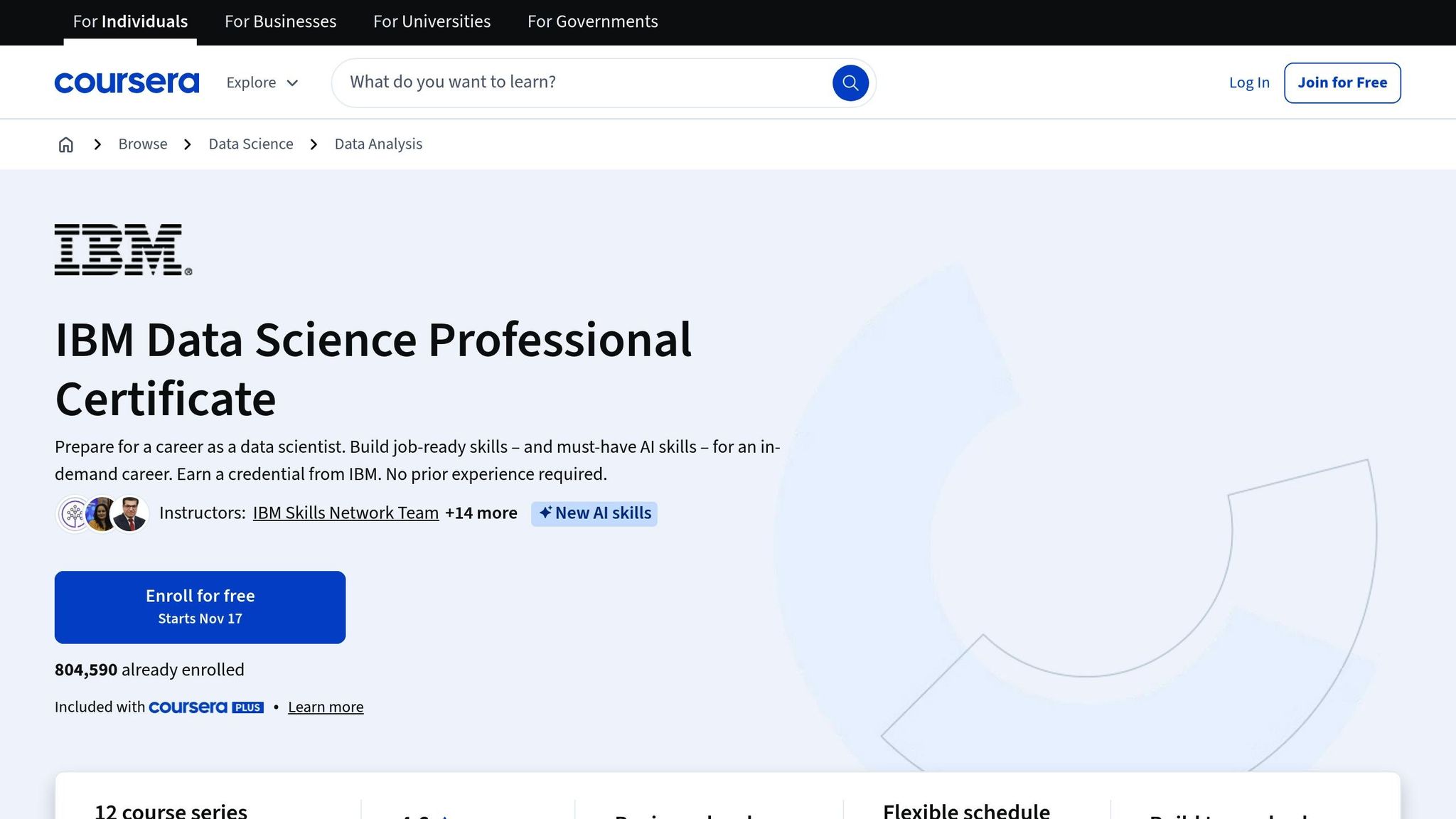
The IBM Data Science Professional Certificate is a beginner-friendly program designed to bridge skill gaps and prepare participants for entry-level roles in data science.
Prerequisites
This program has no prerequisites, making it accessible to those without prior experience in data science or programming. If you have basic computer skills and understand high school-level math, you're good to go. It's a great choice for career changers or recent graduates looking to break into the field.
Key Skills Addressed
The certificate focuses on building core competencies, including:
- Python programming using Jupyter notebooks
- SQL for managing and querying databases
- Data manipulation with pandas
- Data visualization techniques
- Machine learning basics
- Complete data science workflows, from cleaning data to building models
Hands-on projects allow you to create a portfolio that showcases your skills to potential employers.
Program Duration
This self-paced program is designed to be completed in about 11 weeks, assuming you dedicate approximately 3 hours per week. Its flexibility makes it an excellent option for working professionals who want to study during their free time.
Cost (in USD)
The certificate is offered on Coursera for $39 per month. Most learners complete it in around three months, bringing the total cost to about $117. With a course rating of 4.5 out of 5 stars and 26% of participants reporting career advancements, it’s a worthwhile investment.
For those aiming to transition into data science or refine specific skills, this program provides a strong, industry-recognized foundation. Up next, we’ll dive into the HarvardX Data Science Professional Certificate to expand your learning options.
2. HarvardX Data Science Professional Certificate (edX)
After the IBM certificate's beginner-oriented approach, the HarvardX Data Science Professional Certificate steps up the game by diving deeper into statistical and analytical skills. Backed by Harvard's reputation, this program emphasizes the core principles of statistics and R programming, offering a solid foundation in data science.
Prerequisites
While this program welcomes beginners, having a basic understanding of high school-level math, statistics, and a bit of R programming can be helpful. If you're ready to start learning programming from scratch and have a handle on essential math concepts, this course is a great starting point.
Key Skills Addressed
The curriculum focuses on essential topics like statistical analysis, data wrangling, visualization, probability, inference, and machine learning - all taught using R. Hands-on capstone projects, such as analyzing U.S. crime data, predicting movie ratings, or working with genomic datasets, provide practical experience and help you build a portfolio. These projects are designed to bridge the gap between theory and practice, equipping you to tackle real-world problems with confidence.
Program Duration
This self-paced program typically takes 9 to 12 months to complete, assuming a commitment of 2 to 4 hours per week. The flexible structure allows you to adjust your learning speed to fit your schedule, whether you prefer to move quickly or take your time.
Cost (in USD)
The full program costs around $991 USD as of 2025. If you'd rather pay per course, each one is priced at approximately $99 USD. For those who qualify, edX provides financial assistance to make the program more accessible. Impressively, over 26% of learners have reported landing a new job after completing this certificate, highlighting its value in the job market. With Harvard's strong academic framework, practical projects, and industry relevance, this certification is a standout choice for anyone looking to build or enhance their data science skills.
3. Google Professional Data Engineer
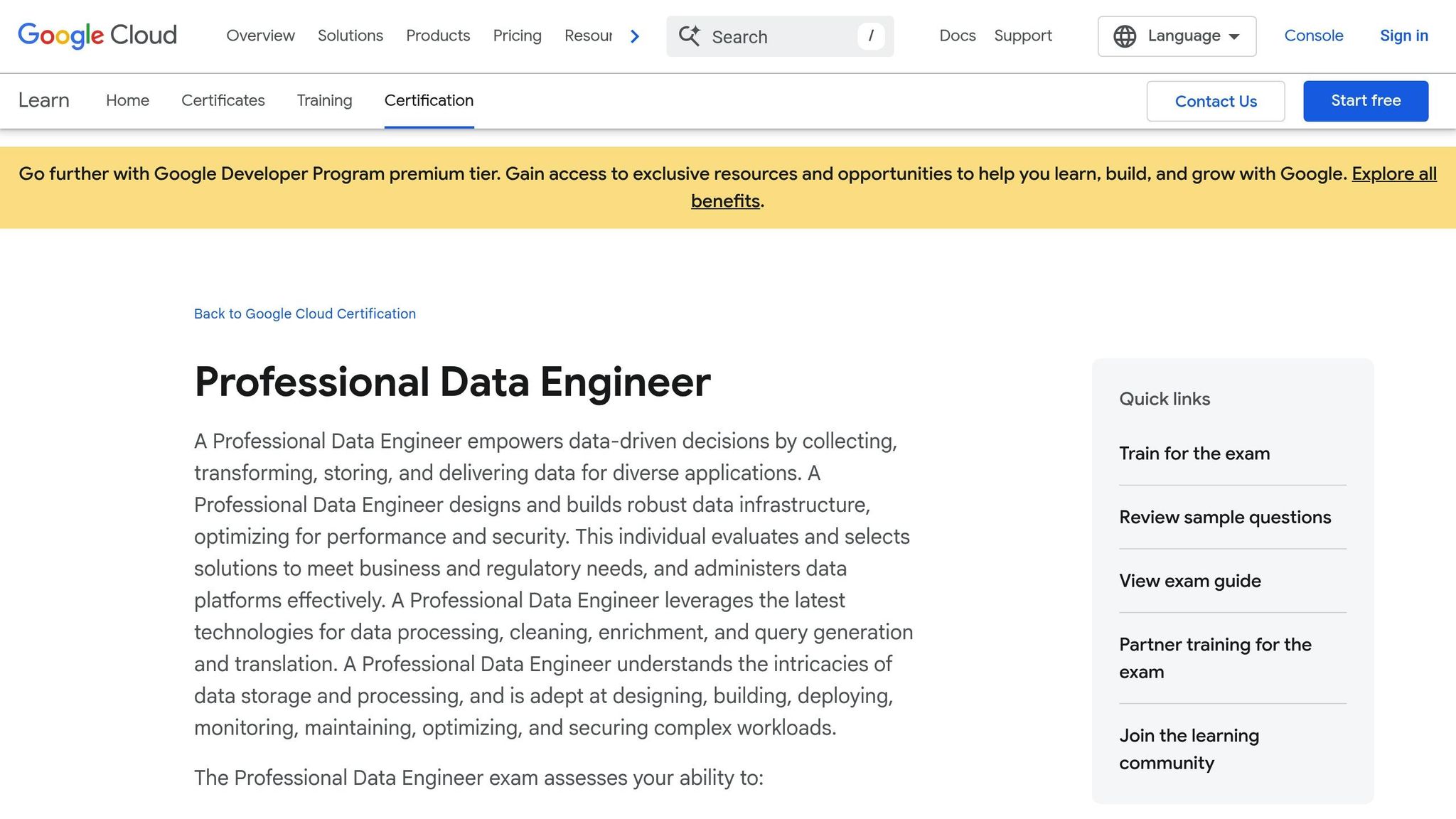
Shifting gears from HarvardX's academic focus, the Google Professional Data Engineer certification offers a practical, cloud-based approach for professionals looking to prove their expertise in designing, building, and managing data systems on the Google Cloud Platform (GCP).
Prerequisites
To tackle this certification, candidates should bring at least 3 years of industry experience to the table, including 1 year working with Google Cloud solutions. A solid understanding of data modeling, ETL processes, and SQL is also essential.
Key Skills Covered
This certification emphasizes key competencies like designing efficient data processing systems, managing both batch and streaming pipelines, and integrating machine learning models. It also focuses on critical areas such as data ingestion, transformation, storage, and ensuring data reliability and security within the Google Cloud environment.
Program Duration
The exam is a 2-hour test featuring 50–60 scenario-based and multiple-choice questions. Preparation typically takes most candidates 2 to 4 months, with a commitment of 10 to 15 hours per week. This adds up to around 80 to 120 hours of study, which includes practice exams and hands-on lab sessions.
Cost (in USD)
The exam fee is $200 per attempt, with no discounts offered for retakes, which also cost $200 each. Google provides a variety of free preparation resources, such as official documentation, practice labs, and training events. However, some candidates opt for third-party study materials or courses, which can cost anywhere between $50 and $300.
Highly regarded by employers, this certification serves as a strong validation of expertise in cloud data engineering, making it a valuable asset for professionals in cloud-focused roles.
Up next, we’ll dive into another sought-after certification: the Microsoft Azure Data Scientist Associate.
4. Microsoft Azure Data Scientist Associate
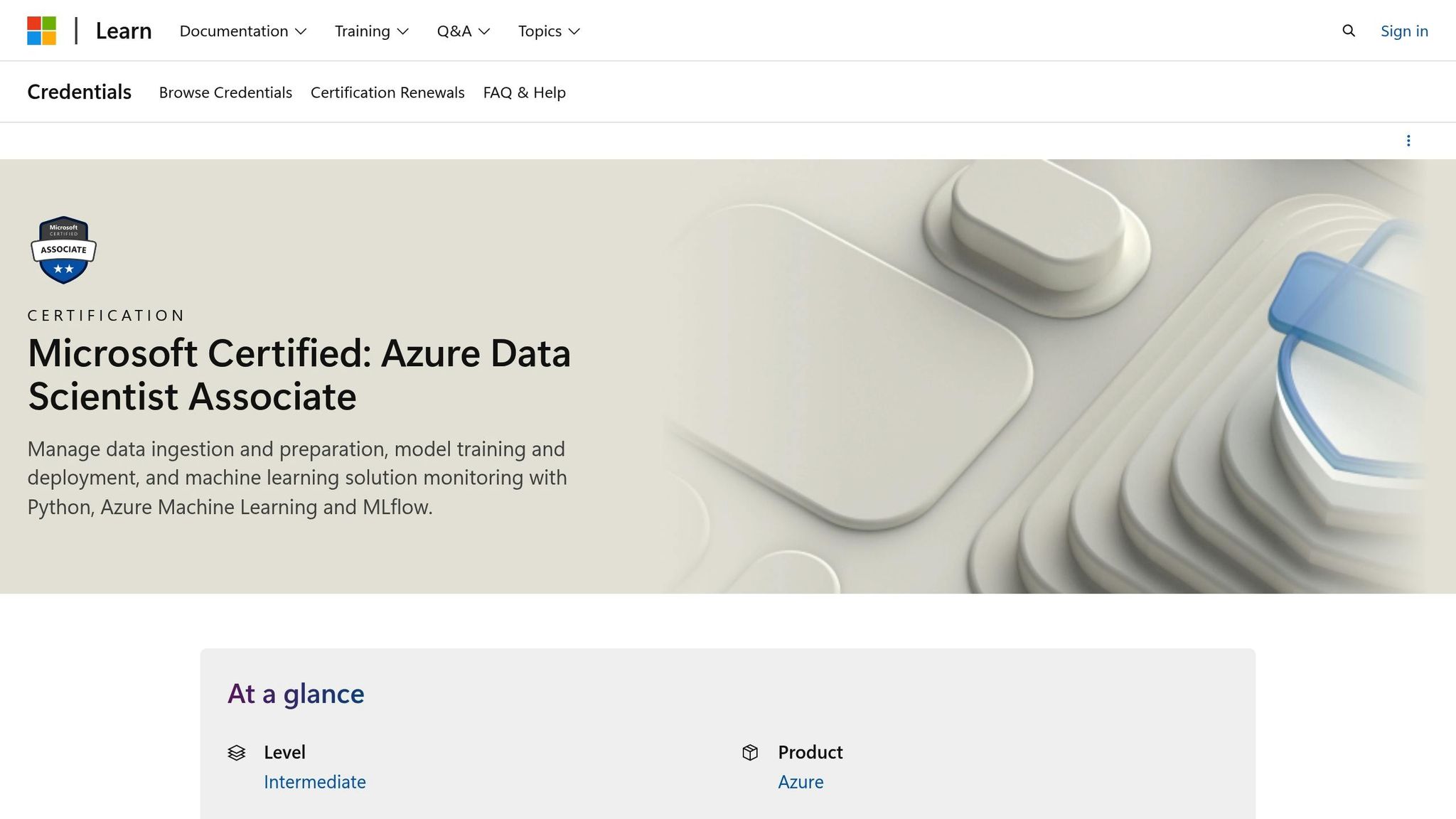
The Microsoft Azure Data Scientist Associate certification demonstrates your ability to create and deploy data science and machine learning solutions using Microsoft Azure.
Prerequisites
While Microsoft doesn’t enforce strict prerequisites, candidates should have practical experience with data science projects, a strong understanding of machine learning principles, and familiarity with Python. Basic knowledge of cloud concepts and hands-on experience with Azure Machine Learning and MLflow are also recommended. This certification is particularly suited for professionals already working on data science projects who want to showcase their expertise in building and deploying machine learning solutions on Azure.
Key Skills Covered
This certification combines core data science knowledge with advanced cloud-based machine learning techniques. It assesses your ability to design, implement, and deploy machine learning models within Azure. Key skills include data preparation, feature engineering, model training and evaluation, and operationalizing and monitoring models using Azure Machine Learning. Real-world applications include tasks like predictive maintenance and customer churn prediction.
Program Duration
Preparation typically spans 2 to 4 months, depending on the learning approach. Self-paced modules and instructor-led training are available, offering hands-on labs and practice exams to build practical skills.
Cost (in USD)
The exam fee is $165 USD, making it a cost-effective choice among cloud-focused data science certifications. Additional costs may apply for optional study resources or courses. Microsoft supports candidates with official learning paths on Microsoft Learn, as well as documentation, tutorials, and practice labs.
This certification is highly regarded by organizations leveraging Azure, blending data science expertise with cloud-based AI capabilities.
Next, we’ll explore the SAS Certified Data Scientist certification, which emphasizes statistical analysis and traditional data science methods.
5. SAS Certified Data Scientist
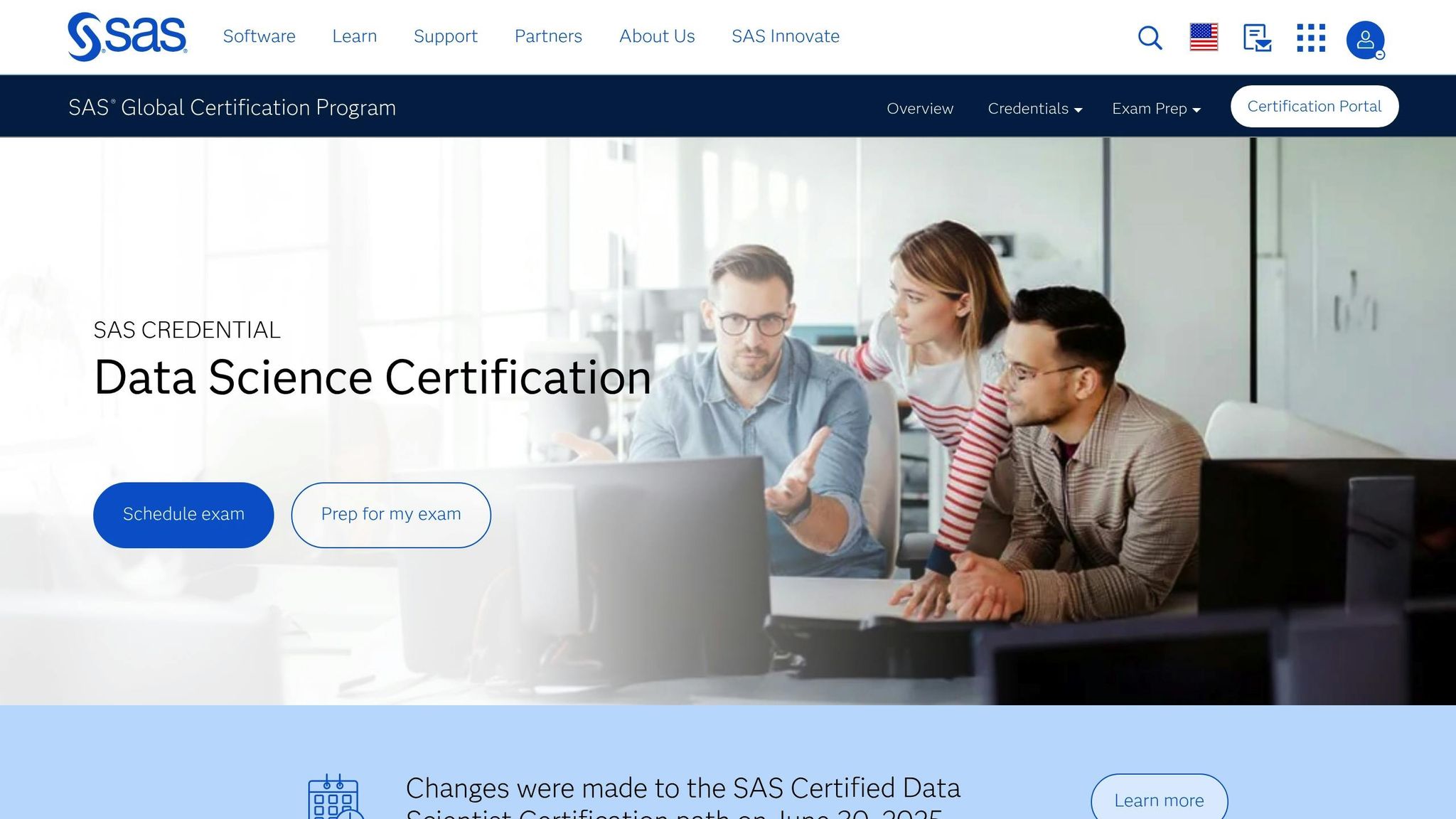
The SAS Certified Data Scientist certification showcases your expertise in advanced analytics and SAS tools. It's a credential widely recognized by Fortune 500 companies and government agencies.
Prerequisites
To pursue this certification, you’ll need a strong grasp of SAS programming and data manipulation. Familiarity with SQL and prior experience in data analysis and statistical concepts are also essential. This certification is best suited for those already skilled in SAS, aiming to validate their advanced capabilities.
Key Skills Covered
This program equips you with advanced analytics skills, including big data management, machine learning, and data curation using SAS tools. You'll dive into areas like data preparation, statistical modeling, predictive analytics, and deploying machine learning models in practical business settings. The program includes capstone projects, giving you a chance to build a portfolio that highlights your applied expertise.
Program Duration
Most participants complete the program within a few months, depending on their pace and prior experience.
Cost (in USD)
The certification involves modular exams, each costing approximately $180. Expect to spend several hundred dollars to complete the full certification.
For professionals aiming for senior roles in organizations that rely on SAS for analytics, this certification is a valuable asset. It not only validates your expertise but also helps identify and address any skill gaps along the way.
Up next, consider exploring the Udacity Data Scientist Nanodegree for a hands-on, project-based learning experience.
sbb-itb-8dc0621
6. Udacity Data Scientist Nanodegree
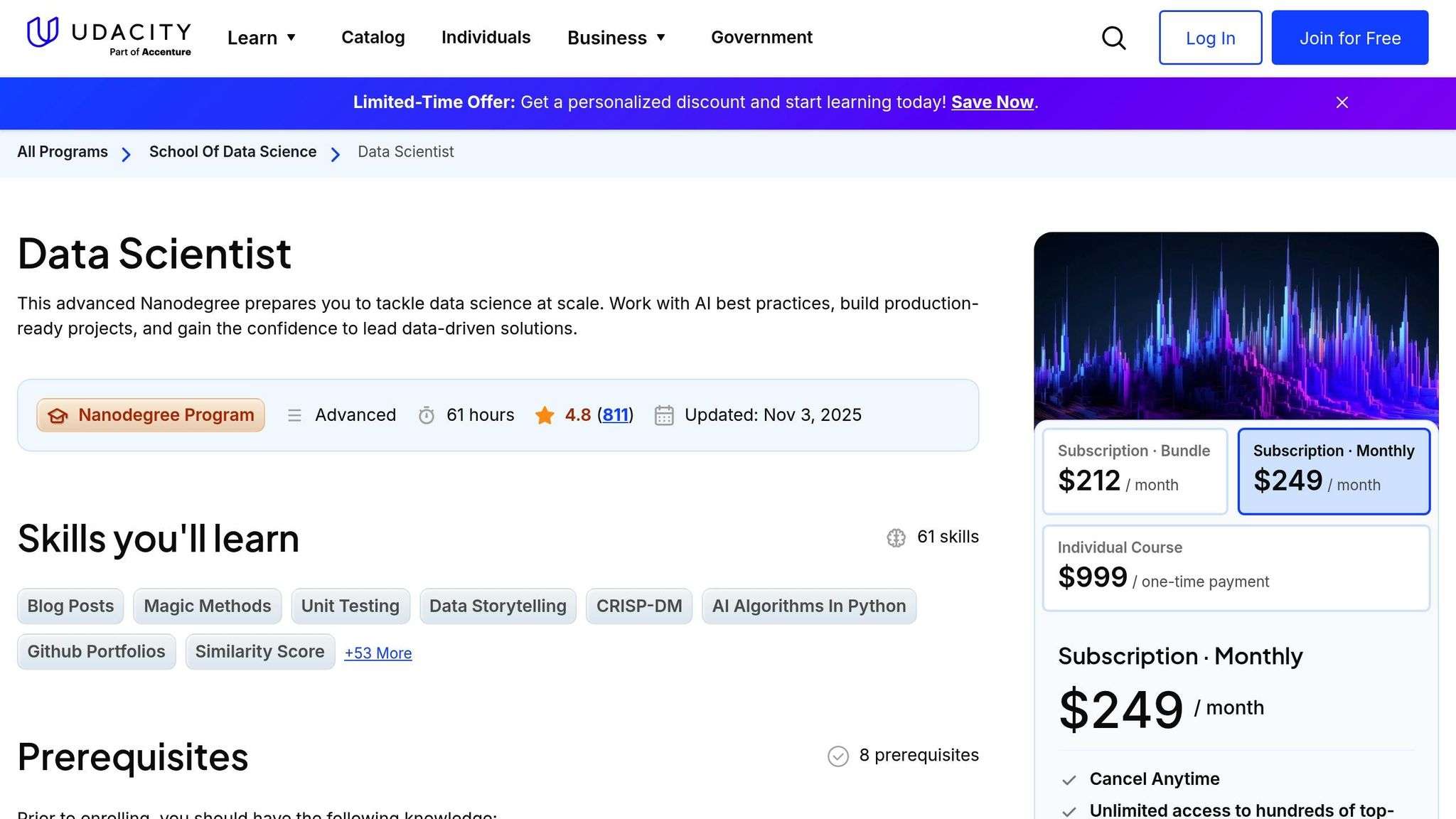
The Udacity Data Scientist Nanodegree focuses on hands-on learning through projects, helping students build a professional portfolio. With partnerships from top tech companies like Kaggle and Figure Eight, the program ensures its curriculum remains aligned with industry demands.
Prerequisites
To enroll, you should have intermediate Python skills and familiarity with libraries like pandas, NumPy, and matplotlib. A basic understanding of statistics is also recommended. While prior knowledge of machine learning concepts can give you an edge, it’s not a strict requirement.
Key Skills Addressed
This program fills critical skill gaps by guiding students through five real-world projects. These include building recommendation systems, analyzing large datasets, and deploying machine learning models. You'll develop expertise in:
- Data wrangling and exploratory data analysis
- Machine learning and deep learning
- Data visualization
The curriculum uses industry-standard tools like Python, scikit-learn, TensorFlow, and Jupyter Notebooks. It also dives into cloud platforms such as AWS and Google Cloud, addressing the often-overlooked need for production deployment skills. Each project is reviewed by industry professionals to ensure your work meets professional standards, preparing you for real-world challenges from day one.
Program Duration
The program is designed to be completed in about 4 months with a commitment of 10 hours per week. However, the self-paced format allows flexibility, with many students - especially working professionals - finishing within 6 to 8 months. This makes it a great option for those balancing the program with full-time jobs or other responsibilities.
Cost (in USD)
The cost is $399 per month, with the total typically coming to around $1,596. Udacity offers flexible payment plans and occasionally provides discounts for upfront payments. Financial aid is available for eligible learners, and scholarships are sometimes offered through partnerships with organizations.
Udacity reports that 73% of graduates experience positive career outcomes - such as landing new jobs, earning promotions, or receiving salary increases - within six months of completing the program. The program receives high ratings, often between 4.5 and 4.7 out of 5, with students praising the hands-on projects, mentor support, and career services.
This nanodegree offers a practical, project-driven learning experience with a strong focus on career readiness. It’s an excellent choice for anyone looking to close skill gaps and advance in the field of data science. Up next is a more academically focused option: the MITx MicroMasters Program in Statistics and Data Science.
7. MITx MicroMasters Program in Statistics and Data Science
The MITx MicroMasters Program in Statistics and Data Science stands out as an academically demanding option. Offered by MIT through edX, this graduate-level program provides in-depth training for professionals aiming to excel in statistical modeling and machine learning.
What makes it unique is its stackable credential system, allowing learners to earn credit toward a full master's degree at MIT or partner universities. With over 100,000 participants worldwide, the program maintains a rigorous academic standard, evidenced by its 15% completion rate, highlighting the level of challenge it presents.
Prerequisites
To enroll, you'll need a solid foundation in college-level calculus, linear algebra, and basic Python programming. While a formal degree isn't mandatory, being comfortable with advanced mathematics and statistics is crucial for navigating the coursework successfully.
Key Skills Covered
The program includes five graduate-level courses: Probability, Statistics, Data Analysis, Machine Learning, and a Capstone Exam. These courses build expertise in areas like statistical modeling, data visualization, and practical machine learning through hands-on projects and real-world case studies.
Some examples of real-world applications include:
- Analyzing large datasets to uncover trends
- Developing predictive models for business scenarios
- Completing a capstone project that integrates all the concepts learned
The curriculum is designed to mirror challenges faced by data scientists in both industry and research settings.
Program Duration
The program typically takes 12 to 18 months to complete, depending on your pace and availability. Its self-paced format offers flexibility, making it ideal for working professionals. However, the coursework demands consistent effort, as each course builds on the previous one. Staying on track is key to mastering the material.
Cost (in USD)
The total cost is $1,350, which includes all five courses and the capstone exam. If you'd prefer to pay as you go, each course costs around $300, allowing you to spread out the financial commitment. Given the graduate-level content and the prestige of an MIT credential, the investment offers strong value in the job market.
Graduates often experience career growth, including promotions, new job opportunities, and salary increases, thanks to the program's association with MIT.
This MicroMasters program provides a robust theoretical foundation, making it an excellent choice for those aiming to master advanced statistical and machine learning concepts. Up next, we’ll take a closer look at the Certified Analytics Professional (CAP) certification.
8. Certified Analytics Professional (CAP)
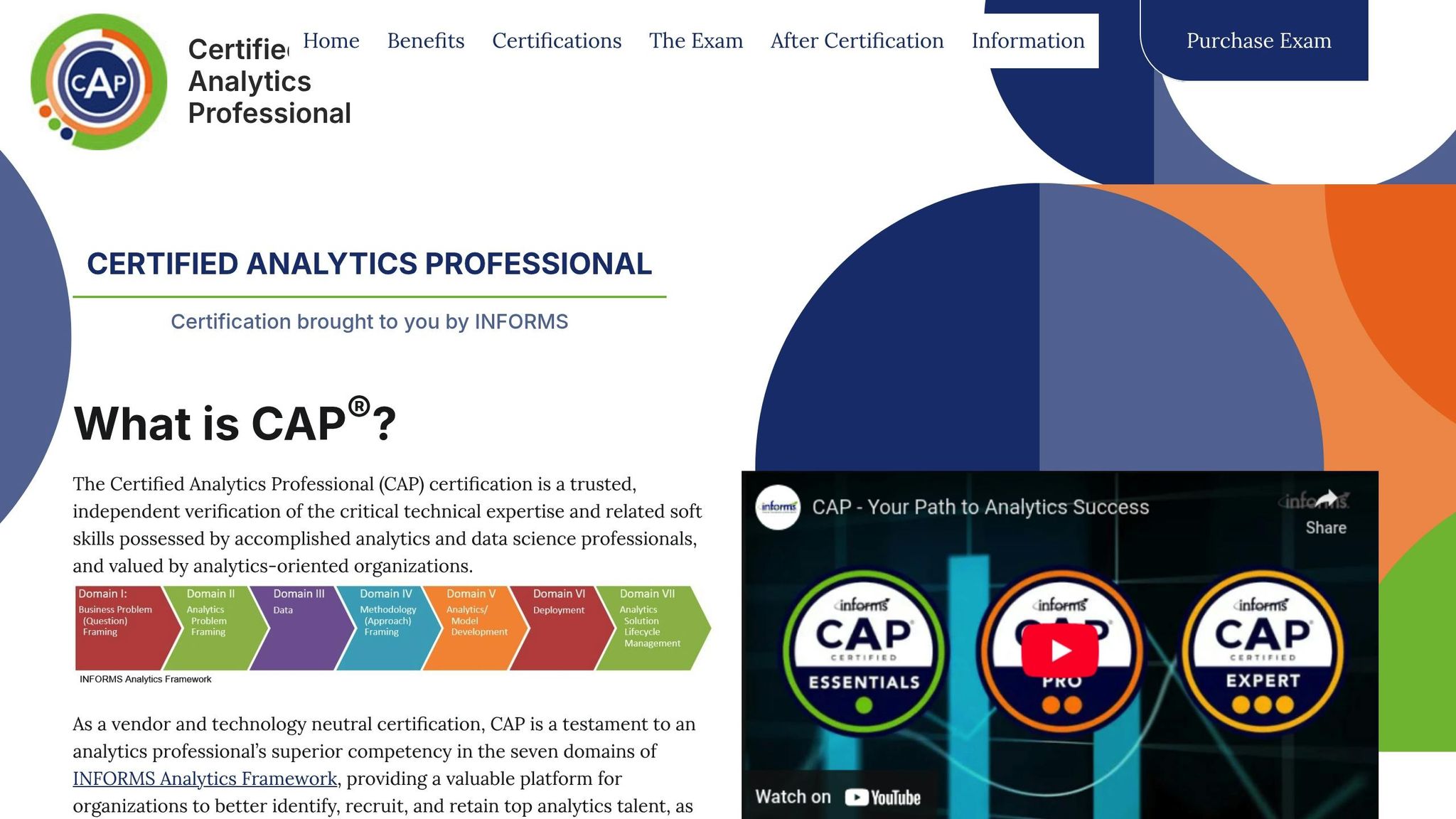
The Certified Analytics Professional (CAP) certification shifts the focus from purely technical skills to a more strategic, business-oriented approach to analytics. Offered by INFORMS, this globally recognized credential covers the entire analytics process. It's tailored for experienced professionals who want to showcase their ability to turn complex business challenges into actionable analytics solutions.
What sets CAP apart is its emphasis on connecting technical analytics with real business value - an essential skill for leadership roles. It ensures professionals not only understand analytics but also know how to apply it effectively within a business context.
Prerequisites
To qualify for the CAP certification, candidates must meet specific requirements:
- A bachelor’s degree with at least five years of analytics experience, or a master’s degree with three years of experience.
- Adherence to the CAP Code of Ethics.
- Completion of an eligibility review before taking the exam.
These prerequisites ensure that candidates have hands-on experience in applying analytics to solve real-world business problems.
Key Skills Addressed
The CAP certification covers seven key areas of the analytics process:
- Framing business problems
- Framing analytics problems
- Selecting data methodologies
- Preparing data
- Building models
- Deploying solutions
- Managing the model lifecycle
The exam uses scenario-based questions to test not just technical know-how but also the ability to translate business needs into effective analytics solutions. This approach helps bridge common skill gaps among data professionals.
Program Duration
The time needed to prepare for the CAP exam depends on individual experience, but most candidates spend two to six months studying. The process includes submitting an application, completing a three-hour exam, and undergoing a soft skills assessment. As preparation is self-paced, candidates can adapt their study schedules to fit around work and other commitments, focusing on practical applications of analytics concepts.
Cost (in USD)
The CAP exam costs $695 for INFORMS members and $795 for non-members. There’s also a $100 application fee, which is applied toward the exam fee once approved. The certification is valid for three years, after which professionals must complete 30 professional development units and pay a recertification fee ranging from $100 to $200 to maintain their credential.
CAP-certified professionals often report benefits like higher salaries and better career opportunities. This certification complements technical credentials by equipping professionals with a broader, business-focused perspective on analytics.
For additional resources to help close analytics skill gaps and advance your career, check out Bridged.
Certification Comparison Table
Here’s a breakdown of eight key data science certifications, summarizing prerequisites, core skills, duration, and costs. Use this guide to help pinpoint the certification that aligns with your career goals.
| Certification | Prerequisites | Key Skills Addressed | Program Duration | Cost (USD) |
|---|---|---|---|---|
| IBM Data Science Professional Certificate | None | Python, SQL, data analysis, machine learning, visualization | 3–6 months (11 weeks at 3 hrs/week) | $39/month |
| HarvardX Data Science Professional Certificate | Basic math, statistics, programming | R programming, statistics, machine learning, data wrangling | 9 courses, self-paced | Approximately $792 total |
| Google Professional Data Engineer | 3+ years industry experience, 1+ year with Google Cloud | Data engineering, machine learning, cloud deployment | Short preparation period | $200 exam fee |
| Microsoft Azure Data Scientist Associate | Experience with Azure Machine Learning | Machine learning, Azure platform, model deployment | Short preparation period | $165 exam fee |
| SAS Certified Data Scientist | SAS programming, SQL basics | Data curation, advanced analytics, machine learning with SAS | Multiple exams required | $540–$720 total |
| Udacity Data Scientist Nanodegree | Python basics, statistics, machine learning fundamentals | Python, machine learning, deep learning, hands-on projects | 4–6 months | $399/month |
| MITx MicroMasters in Statistics and Data Science | College-level mathematics, statistics | Probability, statistics, machine learning, data analysis | 1–1.5 years | $1,350 total |
| Certified Analytics Professional (CAP) | Bachelor's + 5 years experience or Master's + 3 years | Analytics process, business problem framing, model lifecycle | Self-paced exam preparation | $695–$795 |
For beginners on a tight budget, IBM’s certificate at $39 per month and Microsoft Azure’s certification with a $165 exam fee are affordable starting points. IBM’s program, lasting about 11 weeks, could cost between $117 and $234, depending on your pace.
If you’re an experienced professional, certifications like Google’s Professional Data Engineer and Microsoft Azure Data Scientist are exam-based and require only a few weeks of focused study. These are ideal for those with prior industry experience.
For more in-depth academic training, HarvardX offers a self-paced curriculum in R programming and statistics for about $792. Alternatively, the MITx MicroMasters provides university-level coursework for $1,350. If enhancing business-focused analytics skills is your goal, the CAP certification covers the entire analytics process, from framing business problems to deploying models, though it requires substantial professional experience.
Financial aid is available for several programs. Coursera offers need-based assistance for IBM and Google certifications, while edX provides scholarships for HarvardX and MITx, potentially lowering costs for eligible learners.
When deciding, think about your current skills, time commitment, and budget. Platforms like Bridged can also help you identify and address specific skill gaps.
Conclusion
The field of data science evolves rapidly, and staying ahead is essential for both salary growth and career advancement. These eight certifications provide targeted ways to develop essential skills, whether you're starting from scratch or aiming to deepen your expertise in areas like cloud-based machine learning.
Your choice of certification should align with your current experience level. For beginners, programs like IBM's Data Science Professional Certificate (priced at $39 per month) or Microsoft's Azure Data Scientist Associate ($165) offer a solid foundation. On the other hand, seasoned professionals can validate their expertise with certifications such as Google's Professional Data Engineer or SAS Certified Data Scientist.
Once you've selected a certification, make sure it fits into your broader career plan. Study job postings in your desired field to identify which certifications are most valued by employers. This ensures you're focusing on skills that directly enhance your employability, rather than pursuing credentials that may not provide a tangible career boost.
Remember, earning a certification is just the beginning. To truly advance, apply your knowledge through real-world projects and build a portfolio that showcases your abilities. Track your progress by monitoring measurable outcomes, like increased interview opportunities or salary growth within six to twelve months, to ensure your certification investment pays off.
If you're unsure which certification aligns with your career goals, platforms like Bridged can help you explore lucrative job options and identify the skills you need to achieve your target role. The effort you put into addressing skill gaps today can open doors to better opportunities and higher earning potential in the future.
Take charge of your data science career by selecting a certification that matches your experience, committing to the learning process, and moving closer to the role you aspire to achieve.
FAQs
How can I select the best data science certification for my career goals and skills?
Choosing the right data science certification starts with understanding your current abilities, career aspirations, and the areas where you want to grow. Are you looking to sharpen your programming skills, dive deeper into machine learning, or master data visualization? Pinpointing these focus areas is the first step.
Next, look into certifications that match those skills and are well-regarded by employers in your target industry. A certification that aligns with both your goals and market demand can make a big difference in your career trajectory.
Tools like Bridged can simplify this process by suggesting certifications tailored to your objectives and identifying any skill gaps you may need to address. Armed with this knowledge, you can make informed decisions about which certifications will help you move forward and land those high-paying roles.
What are the costs and time requirements for the data science certifications listed in the article?
Certifications can come with a wide range of costs and time commitments. Prices usually depend on the provider, with fees ranging anywhere from a few hundred dollars to several thousand. The time required to complete a certification also varies - some programs might only take a few weeks, while others could stretch over several months.
If you're aiming to find certifications that align with your career objectives, Bridged provides tools to help pinpoint your skill gaps and suggest certifications that can help you move forward in your professional journey.
Can I use these certifications to transition into a data science career if I don’t have a technical background?
These certifications are tailored to assist individuals from non-technical backgrounds in developing the skills necessary for a career in data science. They often emphasize foundational topics like data analysis, programming, and machine learning, making it accessible for beginners without prior experience.
By leveraging your existing transferable skills and focusing on areas where you need improvement, these certifications can help you build the confidence and expertise needed to thrive in the data science field.
Related Blog Posts


