




Introduction
Freelancing and contracting are two popular ways to work independently, but they differ in structure, income stability, and client relationships.
- Freelancing: You work with multiple clients, handle short-term projects, and have full control over your schedule. It offers flexibility but requires managing your own business, including transferring your professional skills to find clients and handling taxes.
- Contracting: You typically work with one client for a set period (3–6 months), often as part of their team. It provides steady income and a structured environment but comes with less freedom in scheduling.
Quick Comparison
| Feature | Freelancing | Contracting |
|---|---|---|
| Clients | Multiple | One at a time |
| Duration | Short-term projects | Fixed-term (3–6 months) |
| Schedule | Self-managed | Often follows client’s hours |
| Income | Variable | Steady during contract |
| Work Location | Remote | Remote, hybrid, or on-site |
| Integration | Independent | Embedded in client’s team |
| Admin Work | High (marketing, invoicing) | Lower (fewer clients to manage) |
Both paths have pros and cons, so your choice depends on what you prioritize: freedom and variety (freelancing) or stability and structure (contracting).
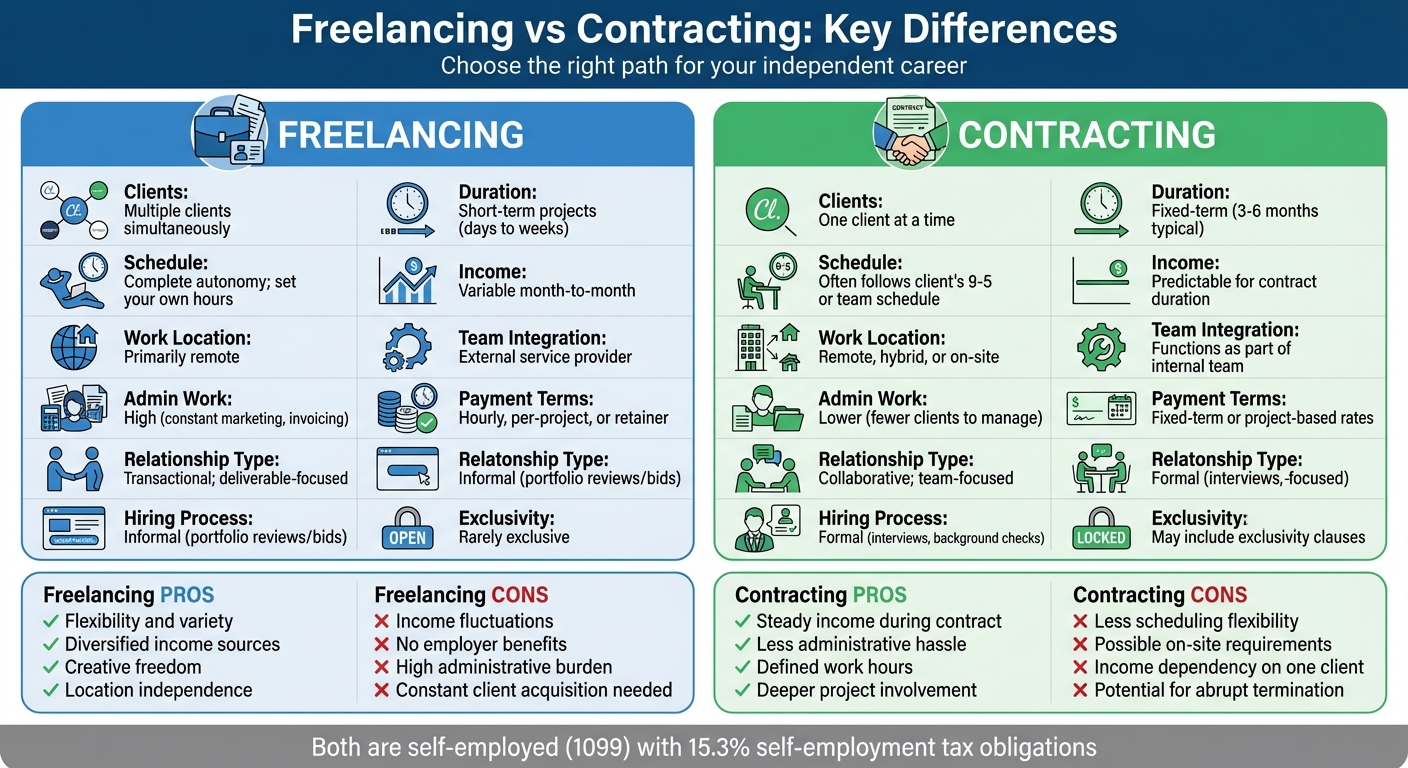
Freelancing vs Contracting: Complete Comparison Guide
The difference between Freelancing and Contracting?
sbb-itb-8dc0621
What Is Freelancing?
Freelancing is a form of self-employment where you offer services on a project-by-project basis to various clients. You have the freedom to set your own rates, choose where you work, and decide which projects to take on.
"This structure gives freelancers the autonomy and flexibility to choose which projects to take on, allowing them to set their schedules, manage their clients, determine their rates, and ultimately, control the trajectory of their careers."
– Veruska Anconitano, Multilingual SEO and Localization Consultant, Freelancing Journal
What sets freelancing apart is the client relationship. Freelancers are seen as independent collaborators or service providers, not permanent employees. You handle your own invoicing, track your time, pay your taxes, and market your services to attract new clients - all while managing the day-to-day operations of your business.
Let’s break down how freelancing works and explore its benefits and challenges. If you are just getting started with your career path, understanding these dynamics is crucial.
How Freelancing Works
Freelancers often juggle several clients at once, each with unique projects and deadlines. For example, you might spend one week writing blog posts, optimizing your resume for new gigs, and building websites. This variety not only keeps things interesting but also reduces the financial risk of losing income if one client relationship ends.
You control your schedule as long as you meet deadlines, and you decide where to work - whether it’s your home office, a coffee shop, or anywhere with an internet connection.
Freelance jobs are typically short-term and focused on specific projects. Popular fields include writing, graphic design, web development, social media management, and consulting. The scope of work is often smaller, like producing a few blog posts or designing social media graphics, compared to the longer-term commitments seen in contracting roles.
With this understanding, let’s look at the advantages freelancing offers.
Benefits of Freelancing
Freelancing stands out for its emphasis on freedom and variety.
- Flexibility: You control your schedule, choose your projects, and work from wherever you want. This level of freedom is ideal for those who thrive outside the traditional 9-to-5 routine.
- Diversified Income: Working with multiple clients spreads out your income sources. If one project ends, you still have others to keep your business afloat. This approach also helps you build a wide-ranging portfolio and expand your expertise.
- Specialization Opportunities: For professionals in creative or technical fields, freelancing lets you focus on a niche. By becoming an expert in a specific area, you can attract higher-paying clients and position yourself for faster career growth.
Downsides of Freelancing
Freelancing comes with its own set of challenges, particularly around financial stability and administrative responsibilities.
- Income Fluctuations: Your earnings can vary greatly from month to month, so careful budgeting and financial planning are essential.
- Tax Responsibilities: Freelancers are responsible for paying their own taxes, including the self-employment tax, which covers both the employer and employee portions of Social Security and Medicare. This means making quarterly estimated tax payments and potentially hiring an accountant to stay compliant.
- Lack of Employer Benefits: Unlike traditional employees, freelancers don’t receive perks like health insurance, retirement contributions, or paid time off.
- Administrative Workload: Beyond delivering your services, you’ll spend time on marketing, finding clients, invoicing, and payment collection. These tasks can eat into the time you’d otherwise spend on billable work.
Freelancing offers a unique blend of independence and variety, but it requires careful planning and management to navigate its challenges effectively.
What Is Contracting?
Contracting is a type of self-employment where you work with a single client for a specific period - commonly 3 to 6 months - focused on achieving set goals. Unlike other freelance setups, contracting often places you directly within the client’s workflow, making you an integral part of their operations.
"Contract workers typically take on temporary, project-based roles with a single client at a time... often defined by a fixed agreement, such as a 3- or 6-month contract."
– Alex Zelaya, Lettuce
The main distinction lies in how deeply contractors are embedded in the client’s day-to-day operations. You’ll likely join team meetings, use internal tools and systems, and collaborate closely with the client’s staff. Your responsibilities and deadlines are typically outlined in a formal Statement of Work (SOW) or service agreement.
This structured setup makes contracting more predictable than freelancing but often comes with less flexibility in how you manage your daily schedule. This balance between structure and integration shapes both the advantages and challenges of this work style.
How Contracting Works
Understanding the details of contracting helps explain how it differs from other forms of self-employment.
Contracting is built around fixed-term agreements that clearly outline what you need to deliver and when. These contracts usually last between 3 to 6 months and often demand a full-time, 40-hour-per-week commitment.
"A contract employee adheres to a contract put in place to define the scope of work before accepting an offer."
– Freelancer FAQs
Unlike smaller freelance projects, contracting often involves tackling larger, more intricate tasks. For example, instead of completing a few minor assignments, you might be responsible for developing an entire sales funnel for a product launch. Common fields for contracting include software development, web development, accounting, human resources, and customer service. In specialized industries, contracting roles might extend to professions like doctors, lawyers, or financial analysts.
Since you work exclusively with one client, you become a temporary but essential part of their team. This means using their tools, attending meetings, and aligning your work with their internal systems. The experience often mirrors traditional employment in many ways, minus the long-term commitment and typical employee benefits.
Benefits of Contracting
The structured nature of contracting comes with several perks, particularly for professionals using a career platform to transition from traditional jobs.
- Steady Income: Unlike freelancers who juggle multiple clients, contractors enjoy consistent pay. Whether it’s an hourly rate or a fixed fee, your income remains predictable throughout the contract period, making budgeting and financial planning easier.
- Less Administrative Hassle: With just one long-term client, you spend less time marketing your services or chasing new leads. This allows you to focus on your work rather than constantly searching for the next project.
- Defined Work Hours: A set 9–5 schedule provides clear boundaries between work and personal life.
- Easier Transition: For those moving from traditional employment, contracting offers a familiar structure and reliable income, easing the shift to self-employment.
Downsides of Contracting
While contracting has its advantages, it’s not without drawbacks that might make it less appealing to some.
- Less Flexibility: Contractors often have to adhere to fixed hours or attend mandatory meetings, which can limit personal scheduling freedom compared to freelancing.
- On-Site Work: Some contracts require you to work on-site or follow a hybrid schedule, reducing the location independence many associate with self-employment.
- Income Dependency: Since your earnings rely on a single client, the end of a contract can mean scrambling to find a new opportunity.
- Tax Obligations: Like freelancers, contractors are responsible for self-employment taxes, which include both the employer and employee portions of Social Security and Medicare.
"Contractors benefit from steady projects and clearer expectations, but may have less creative or operational control."
– Alex Zelaya, Lettuce
Contracting strikes a balance between the stability of traditional jobs and the independence of freelancing. It offers a structured work environment while allowing you to maintain your self-employed status.
Freelancing vs. Contracting: Side-by-Side Comparison
This section breaks down the key differences between freelancing and contracting, focusing on work structure, payment, and client relationships. It builds on the earlier discussion of their respective benefits and challenges.
Here's a closer look at how these two models compare.
Work Structure Differences
Freelancers often manage several clients at the same time, working on projects that might last anywhere from a few days to a few weeks. Contractors, on the other hand, typically dedicate themselves to a single client for a set period - usually about 3 to 6 months. They also tend to become more involved in the company’s daily operations.
"Contractors are often embedded more deeply into a company's workflow than freelancers. They may attend team meetings, collaborate on internal tools, or manage parts of a project."
– Manasa Manogaran, Remote
Freelancers generally enjoy the freedom to set their own schedules, while contractors are often required to follow the client’s hours, such as a standard 9-to-5 workday. Additionally, contractor agreements sometimes include exclusivity clauses, which is uncommon in freelancing.
| Feature | Freelancing | Contracting |
|---|---|---|
| Client Volume | Multiple client engagements concurrently | Usually one client at a time |
| Project Duration | Short-term or one-off tasks | Fixed-term (3–6 months typical) |
| Schedule | Complete autonomy; set own hours | Often follows client's 9-to-5 or team schedule |
| Work Location | Primarily remote | Remote, hybrid, or on-site |
| Integration | External service provider | Functions as part of the internal team |
| Exclusivity | Rarely exclusive | May include exclusivity clauses |
Payment and Income Differences
The way freelancers and contractors get paid - and the stability of their income - can vary significantly. Freelancers often charge by the hour, per project, or through retainer agreements. This means their income can fluctuate from month to month, depending on how many projects they take on.
Contractors, however, usually work under fixed-term contracts with set rates, offering more consistent cash flow during the contract period.
| Feature | Freelancing | Contracting |
|---|---|---|
| Payment Terms | Hourly, per-project, or retainer | Fixed-term or project-based rates |
| Income Stability | Low; varies month-to-month | Higher; predictable for contract duration |
| Tax Status | Self-employed (1099) | Self-employed (1099) |
| Admin Burden | High (constant invoicing/marketing) | Lower (fewer clients to manage) |
Client Relationship Differences
The nature of client relationships also sets freelancing and contracting apart. Freelancers usually maintain more transactional relationships that focus on delivering specific outcomes. Communication is often limited to project updates via email or brief check-ins.
In contrast, contractors typically build more collaborative relationships. They often participate in regular team meetings and are more integrated into the client’s daily operations.
"Since [contractors] often work with a single client for an extended period... the contractor may be viewed as an extension of the client's team."
– Veruska Anconitano, Freelancing Journal
The hiring process is another area where the two differ. Freelancers are often hired informally, based on portfolio reviews or bids on platforms. Contractors, however, usually go through a more formal process, including interviews, background checks, and detailed contract negotiations. While contractors may enjoy more income stability, they also face greater dependency on a single client. If a contract ends unexpectedly, their entire revenue stream could be at risk.
| Feature | Freelancing | Contracting |
|---|---|---|
| Relationship Type | Transactional; deliverable-focused | Collaborative; team-focused |
| Interaction Level | Limited; typically via email or brief meetings | High; often involves daily team syncs |
| Hiring Process | Informal (portfolio reviews/bids) | Formal (interviews and background checks) |
| Pros | High variety, independence, diverse network | Financial stability, deeper project involvement |
| Cons | Income uncertainty, constant need for new projects | Less flexibility, potential for abrupt termination |
Legal and Tax Requirements
Legal and tax considerations play a huge role in shaping careers for both freelancers and contractors, beyond just how they work or get paid.
According to IRS guidelines, both freelancers and contractors are classified as self-employed. This means you're responsible for managing your own taxes, insurance, and business expenses - your clients won’t withhold anything for you.
When tax season rolls around, clients who pay you $600 or more are required to issue a Form 1099-NEC, while you’ll need to provide them with a Form W-9. You’ll also be responsible for paying a 15.3% self-employment tax, which covers both the employer and employee portions of Social Security and Medicare. For 2026, the Social Security wage base is set at $176,100. Since taxes aren’t withheld from your payments, you’ll need to make quarterly estimated tax payments to avoid penalties from the IRS.
"I worked with a contractor who made $140K his first year but kept zero records... We salvaged maybe 40% of his actual deductions because the IRS requires contemporaneous documentation."
– David Fritch, Attorney at Fritch Law Office
There’s also a key difference in how contracts and intellectual property (IP) are handled. Freelancers usually work with simpler agreements and often retain copyright to their work, granting clients a license to use it. Contractors, on the other hand, often sign fixed-term "work-for-hire" agreements, which transfer IP ownership to the client. Neither freelancers nor contractors receive traditional employer benefits, which can influence how contracts are negotiated.
Most freelancers and contractors start out as sole proprietors but may later form an LLC or S-Corp to gain liability protection and potential tax benefits. No matter your business structure, having a written contract in place is non-negotiable. It should clearly outline the scope of work, payment terms, and termination conditions. On top of that, keeping detailed records of every business expense from the very beginning is crucial. A solid contract and careful documentation are your best tools for protecting your business.
How to Choose Between Freelancing and Contracting
What to Consider
When deciding between freelancing and contracting, it’s important to think about what matters most to you - whether it’s flexibility, steady income, or a structured work environment.
Freelancing gives you complete control over your schedule, the clients you work with, and the types of projects you take on. It’s perfect if you value variety and want the freedom to work remotely. However, this freedom often comes with challenges like inconsistent income and the need for ongoing self-promotion. On the other hand, contracting provides a more structured setup with fixed schedules, clear workflows, and reliable income from fixed-term agreements.
If income stability is a priority, contracting might be the better choice. Contract roles often come with steady paychecks, opportunities to work on larger, more complex projects, and even higher earnings due to premium rates and tax benefits. Freelancers, however, might face income swings from month to month, though working with multiple clients can help reduce the risk of financial gaps.
Freelancing is great for expanding your skills across a range of industries and niches, while contracting allows you to focus on building expertise in a specific area through longer-term projects. Many professionals start with contracting to gain stability and experience in self-employment before transitioning into freelancing for greater flexibility.
How Bridged Can Help

Bridged simplifies the decision-making process by offering tools like career quizzes and skill gap analysis to help you determine whether freelancing or contracting suits you best. Their skill gap analysis highlights certifications that can enhance your marketability. Plus, Bridged connects you to vetted freelance and contract opportunities with reputable companies, reducing the uncertainty of finding work. Whether you’re exploring your options or have a clear career path in mind, Bridged provides tailored resources and certification recommendations to help you move confidently between freelancing and contracting.
Conclusion
Freelancing and contracting each have their perks, but they cater to different work styles and priorities. Freelancing gives you complete control - you decide your clients, set your own hours, and can manage multiple projects simultaneously. It’s perfect if you thrive on variety and flexibility. On the other hand, contracting offers more stability. You typically work with one client at a time, become part of their team, and enjoy a steady income through fixed-term agreements.
Ultimately, the decision depends on what matters most to you. If you value creative freedom and flexible client selection, freelancing might be your best fit. If you prefer a steady paycheck and the structure of team collaboration, contracting could be the better option.
"Freelancing suits people who like change and independence. Contractor roles fit those who enjoy plugging into a team and settling into a rhythm"
– Vincent Carrié, CEO at Purple Media
Whichever path you choose, formal agreements are essential. Clearly outline your availability, payment terms, and deliverables to avoid misunderstandings and scope creep.
Take time to evaluate your personality, financial needs, and long-term goals before making your choice. Tools like Bridged can help you navigate this decision by highlighting your strengths and matching you with the right opportunities. With resources like career quizzes and skill gap analysis, Bridged simplifies the process of finding the path that aligns with your aspirations. Whether you’re starting out or shifting gears, having the right support can make all the difference in creating a rewarding career.
FAQs
Which pays more, freelancing or contracting?
Freelancers often earn more per hour because they set their own rates, frequently charging extra for their expertise and the flexibility they offer. However, freelancers are responsible for covering their own taxes and insurance, which is one reason their rates tend to be higher. On the other hand, working as a contractor through an agency usually means a lower hourly rate. But it often comes with added perks like benefits and greater stability, as the agency or employer takes care of payroll, taxes, and other administrative responsibilities.
How do I handle taxes as a 1099 worker?
As a 1099 worker, you're classified as self-employed, which means you're in charge of reporting your income and paying taxes directly to the IRS. To do this, you'll need to file a Schedule C (Profit or Loss from Business) alongside your Form 1040 to detail your income and expenses. Additionally, you'll be responsible for paying self-employment taxes (covering Social Security and Medicare), which are calculated using Schedule SE.
It's a smart move to set aside a portion of your income specifically for taxes throughout the year. Consulting with a tax professional or using tax software can make the process smoother and ensure you're meeting all IRS requirements.
What should I include in a freelance or contract agreement?
A freelance or contract agreement needs to spell out the scope of work, payment terms, and key responsibilities to ensure both parties are on the same page. Be sure to include specifics like the deliverables, how many revisions are allowed, payment schedules, and who owns the intellectual property. To strengthen the agreement, add clauses for confidentiality and termination. These components help establish clear boundaries, align expectations, and provide legal protection for everyone involved.
Related Blog Posts


