




Introduction
Micro-certifications are reshaping how people secure technical jobs. They focus on specific skills like data analytics, AI engineering, and cloud computing, making candidates more attractive to employers. Unlike degrees that take years, these programs are short, affordable, and updated frequently to match industry needs. Here’s why they matter:
- Faster Completion: Most take weeks or months, not years.
- Higher Pay: Certified candidates often earn 10–15% more.
- Better Job Matches: Certifications align directly with job requirements.
- Employer Preference: 96% of employers value these credentials in hiring.
With digital badges and metadata, micro-certifications provide verifiable proof of skills, helping candidates stand out in automated hiring systems and ATS and job platforms. They also reduce employers' training costs and help fill skill gaps in industries like AI, healthcare, and cybersecurity. If you're looking to advance your career, micro-certifications are a practical, cost-effective way to build job-ready skills. You can also use ChatGPT to improve your resume and better highlight these new credentials.
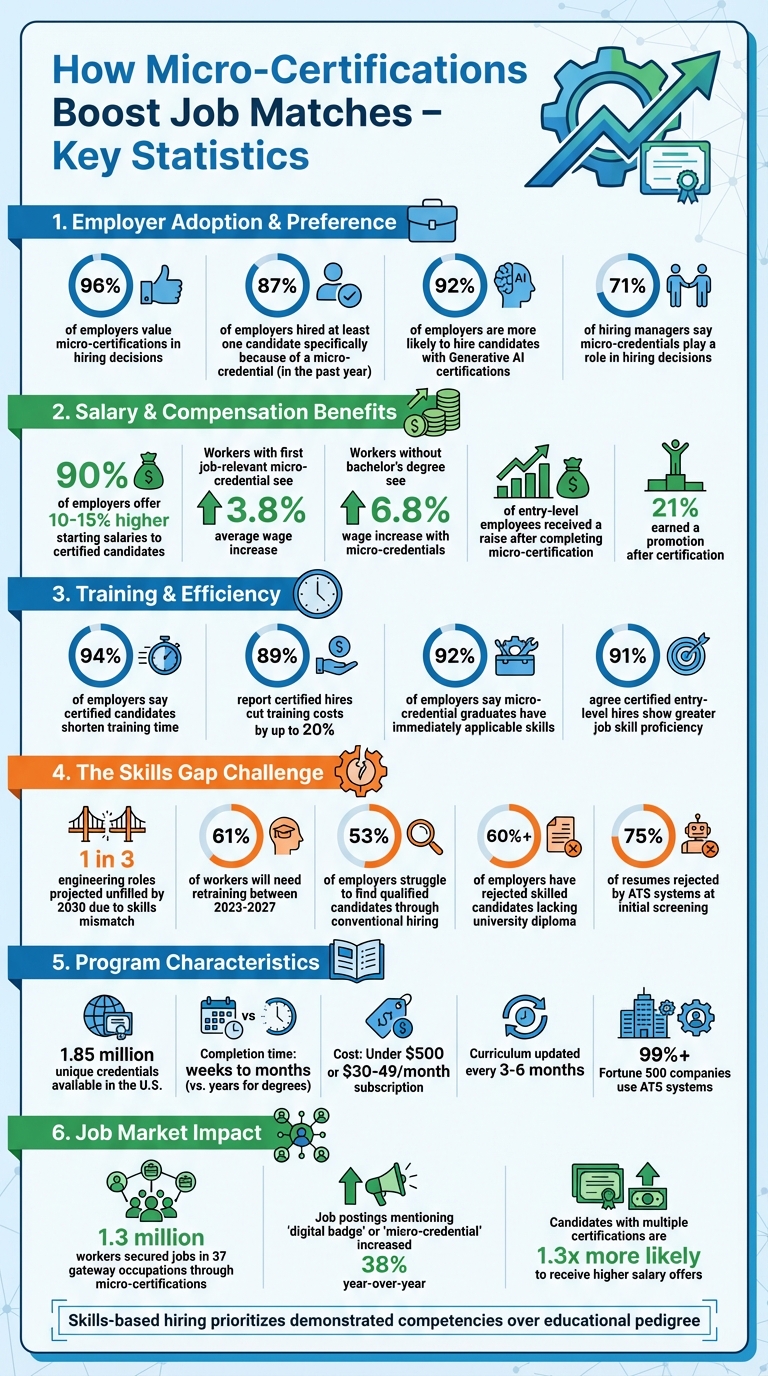
Micro-Certifications Impact on Job Matching and Salaries: Key Statistics
Why Job Matching Fails in Technical Roles
Problems with Standard Job Applications
Traditional resumes just don't cut it for technical roles. Most applicants focus on broad traits like leadership and communication - qualities that are baseline expectations rather than standout skills. Meanwhile, employers are laser-focused on finding candidates with specialized technical expertise. As Eric Bradlow, Vice Dean of AI and Analytics at Wharton, points out:
"The skills that people, that companies are saying they want in job postings are just not the way people are representing themselves."
Another issue? Degrees only show what someone knew at graduation. They don’t reflect whether someone has kept pace with emerging tools, AI-driven workflows, or updated compliance standards. Shockingly, over 60% of employers have rejected skilled candidates simply because they didn’t have a university diploma - even when they had the necessary capabilities. To make matters worse, Applicant Tracking Systems (ATS) often overlook micro-credentials or certifications—though tools like Jobscan can help candidates optimize for these filters, meaning qualified candidates can easily get filtered out. These flaws in the hiring process leave industries struggling to find the right talent with up-to-date technical skills.
The Skills Gap in High-Demand Industries
Industries like AI, finance, and healthcare are feeling the pressure. Traditional education systems can’t keep up with the rapid pace of technological change. Today, technical skills can become outdated in just a few months, while earning a degree or license takes years. Sean Gallagher, Director at Huron Consulting Group, explains the challenge:
"The pipeline to become an engineer... is a long one. So, there are only so many people who are qualified to fill these jobs."
The statistics are eye-opening. By 2030, one in three engineering roles is projected to remain unfilled because workers don’t have the right skills. Between 2023 and 2027, 61% of workers will need retraining to keep up with labor market demands. Traditional degrees don’t provide enough insight into specific skill sets, making it hard for hiring systems to assess whether someone can handle tasks like JavaScript coding or prompt engineering. No wonder 53% of employers say they struggle to find qualified candidates through conventional hiring methods. This growing divide highlights the urgent need for flexible, skills-based credentials that prove candidates are ready for today’s technical challenges.
sbb-itb-8dc0621
Can Micro-Credentials Get You a Job in 2025?
What Are Micro-Certifications?
Micro-certifications are short, focused programs designed to validate specific job skills. Unlike traditional degrees that take years and cover broad subjects, these credentials zero in on the skills employers are actively seeking - like Python programming or cloud architecture.
Typically offered online and at your own pace, these programs can be completed in just days or a few months. This makes them perfect for professionals who can’t step away from their jobs for long periods. Once you finish, you’ll often receive a digital badge. These badges come with metadata that employers can easily verify, showing details like the issuing institution, date earned, and the skills you’ve mastered.
Another big advantage? You can stack different certifications to build a skill set tailored to specific job roles. For instance, pairing a Google Data Analytics Professional certificate with an IBM AI Engineering credential can set you up for machine learning opportunities. With over 1.85 million unique credentials available in the U.S., the possibilities for creating a personalized learning path are practically endless.
Main Features of Micro-Certifications
Micro-certifications stand out for their flexibility and focus. Most programs take anywhere from a week to six months to complete. They’re also affordable, with costs typically under $500 or subscription plans ranging from $30 to $49 per month.
Leading companies like Google, IBM, Microsoft, and Meta have developed these programs to address specific skill gaps in their hiring pipelines. The curriculum is updated every few months - usually every three to six - so you’re always learning tools and techniques that are in demand right now. Employers are taking notice, too. About 96% say these credentials make a job application stronger, and 90% are even willing to offer 10–15% higher starting salaries to candidates with verified digital badges.
Common Micro-Certification Fields
The demand for micro-certifications is especially high in fast-changing industries. Data Analytics programs, for example, prepare candidates for roles with strong earning potential. Generative AI certifications are also hot, with 92% of employers more likely to hire candidates who hold them. Other popular fields include:
- Cloud Computing: Certifications in AWS, Azure, and Google Cloud are highly sought after.
- Cybersecurity: Skills like network security and ethical hacking are in demand.
- UX Design and Digital Marketing: These fields continue to grow rapidly.
- IT Support: Even entry-level roles now offer competitive pay for those with professional certificates.
With such a wide range of options, micro-certifications are reshaping how we approach skill-building and career development.
How Micro-Certifications Improve Job Matching
Micro-certifications do more than just show off your skills - they help you land the right job. Their impact is clear in three main areas: getting through automated screening systems, building trust with hiring managers, and improving job recommendations on career platforms.
Improving ATS Scores
Did you know over 99% of Fortune 500 companies use Applicant Tracking Systems (ATS) to screen resumes? These systems look for specific keywords and skills before a human even sees your application, and unfortunately, about 75% of resumes get rejected at this stage.
Micro-certifications can make all the difference here. They include precise terminology that matches the keywords employers program into their ATS. For example, if a job posting requires "SQL" or "Agile Project Management", having those exact terms in your certifications ensures your resume gets noticed. Modern ATS even scan digital badge metadata, which can further boost your match score.
The benefits are real. Candidates with multiple micro-certifications - like combining Data Analytics with Power BI - are 1.3 times more likely to receive higher salary offers and better visibility in filtered searches. To take full advantage, list your certifications clearly in plain text, including the issuer and date, and avoid using non-text elements that ATS systems might miss. This attention to detail not only helps with ATS but also reassures employers of your qualifications.
Building Employer Trust
Micro-certifications do more than confirm your skills - they show you're committed to professional growth. In fact, 87% of employers have hired at least one candidate in the past year specifically because of a micro-credential. These certifications provide a clear, verified record of your development.
What sets micro-certifications apart is their verification process. Unlike self-claimed skills, these credentials often include metadata or blockchain verification, giving employers instant proof of your expertise. This is especially important in fast-evolving fields like Generative AI, where 92% of employers say they’re more likely to hire candidates with AI and Generative AI certifications. The payoff? Nearly 9 in 10 employers are willing to offer 10–15% higher starting salaries to candidates with recognized credentials.
Better Job Matching on Career Platforms
Once you’ve earned verified skills, career platforms can help you find better job matches. For instance, platforms like Bridged analyze your current skills against job descriptions and recommend certifications to fill any gaps.
By strategically stacking micro-certifications, you can replace years of traditional experience with targeted skills that meet the exact requirements for entry-level technical roles. On LinkedIn, certifications are added directly to your profile, making it easier for recruiters to find you through skill-based keyword searches. Job postings that mention "digital badge" or "micro-credential" have increased by 38% year-over-year, and 71% of hiring managers say these credentials play a role in their hiring decisions.
This process is becoming increasingly AI-driven. Tools now analyze job postings and recommend the top micro-certifications to improve your match for specific roles. This targeted approach ensures you’re investing in the skills that employers are actively looking for, saving you time and effort.
Why Employers Prefer Certified Candidates
Employers use micro-certifications to lower hiring risks, reduce training costs, and achieve quicker results. The stats back this up: 94% of employers believe hiring entry-level candidates with micro-credentials shortens training time, and 89% say certified hires can cut training costs by up to 20%. These advantages translate into faster onboarding and better pay, as explained below.
Shorter Onboarding and Lower Training Costs
Certified candidates come prepared to hit the ground running. According to 92% of employers, graduates with micro-credentials have skills that can be applied immediately on the job. This drastically reduces the time spent on initial training, allowing companies to focus on core tasks right away. Job seekers can use the ultimate career platform to find these training opportunities and bridge the gap to high-paying roles.
The savings go beyond just time. Businesses cut direct training costs, like external courses, and indirect expenses by hiring certified employees who need less hands-on supervision. Geoff Hirsch, Head of Training Services at Microsoft, puts it this way:
"Training pathways and micro-credentials provide a structured approach to skill development, allowing employees to gain expertise in specific areas. These credentials can help technical leaders identify and nurture talent within the organization".
Certified candidates also bring higher productivity from day one. 91% of employers agree that entry-level hires with micro-credentials show greater proficiency in essential job skills. For instance, 88% of AWS-certified professionals report improved teamwork with technical colleagues, leading to smoother projects and fewer communication hiccups. On top of operational efficiency, certified employees often earn higher wages.
Higher Pay for Certified Workers
Employers reward certified candidates with better pay. 90% of companies offer starting salaries that are 10% to 15% higher for certified hires, recognizing their proven abilities and readiness to contribute immediately.
The pay boost doesn’t stop there. Workers with their first job-relevant micro-credential see an average wage increase of 3.8%, which jumps to 6.8% for those without a bachelor’s degree. Additionally, 28% of entry-level employees received a raise, and 21% earned a promotion after completing a micro-credential. Employers see these certifications as evidence of a candidate’s dedication to staying aligned with industry trends - especially in fast-evolving areas like Generative AI, where 92% of employers are more inclined to hire candidates with relevant AI and Generative AI courses.
Results: Micro-Certifications in Practice
Micro-certifications are helping job seekers enter technical roles more quickly and with better salaries. These programs have already enabled 1.3 million workers to secure jobs in 37 gateway occupations that offer growth opportunities without requiring a four-year degree.
Examples from IT and Emerging Technology
In February 2026, Dominic Eldridge landed a cybersecurity role at GE after earning nine certifications over 14 months, including CompTIA A+, Linux+, CCNA, and MCSE. These credentials caught the attention of a recruiter, leading to his placement as an Information Security Event Analyst. Reflecting on his journey, Eldridge shared:
"Certifications are a great way to validate your technical knowledge and make it easier to find employment and higher pay".
Similarly, in March 2023, Twannetta W., a Florida-based professional, used the SkillUp Coalition's career services and certifications to pivot her career. By focusing on short-term certifications and leveraging career coaching, she transitioned into high-opportunity roles without pursuing a four-year degree. She described her experience:
"I envision this being a true one-stop shop that serves anyone no matter where they are in their career".
These stories highlight how targeted certifications can directly improve job placement in technical fields.
Data from Career Platforms
Beyond individual successes, data from career platforms reveals the broader impact of micro-certifications. Platforms like Bridged use advanced tools to connect job seekers with relevant certifications and employers. For instance, Bridged identifies skill gaps by analyzing users' current abilities against job requirements for roles such as SEO Analyst, UX Researcher, or QA Engineer. It then recommends specific certifications to bridge those gaps.
To ensure the credentials are meaningful, Bridged curates certifications from trusted providers like Google, AWS, HarvardX, and the University of Illinois. Once users complete their certifications, the platform matches them with job openings tailored to their new skills. Steve Lee, CEO of SkillUp Coalition, emphasized the value of this approach:
"We're thrilled to launch this new product experience that offers personalized support and aligns with the needs of millions of workers skilled through alternative routes (STARs) on their journey to high-opportunity jobs".
Additionally, platforms like LinkedIn Learning enhance visibility for job seekers. Certifications added to professional profiles allow candidates to show up in recruiter searches based on skill keywords, a key method for sourcing technical talent. With over 900 short-term programs available through vetted training catalogs, job seekers have affordable options to prepare for in-demand careers.
How to Get Started with Micro-Certifications
Using Bridged for Career Planning
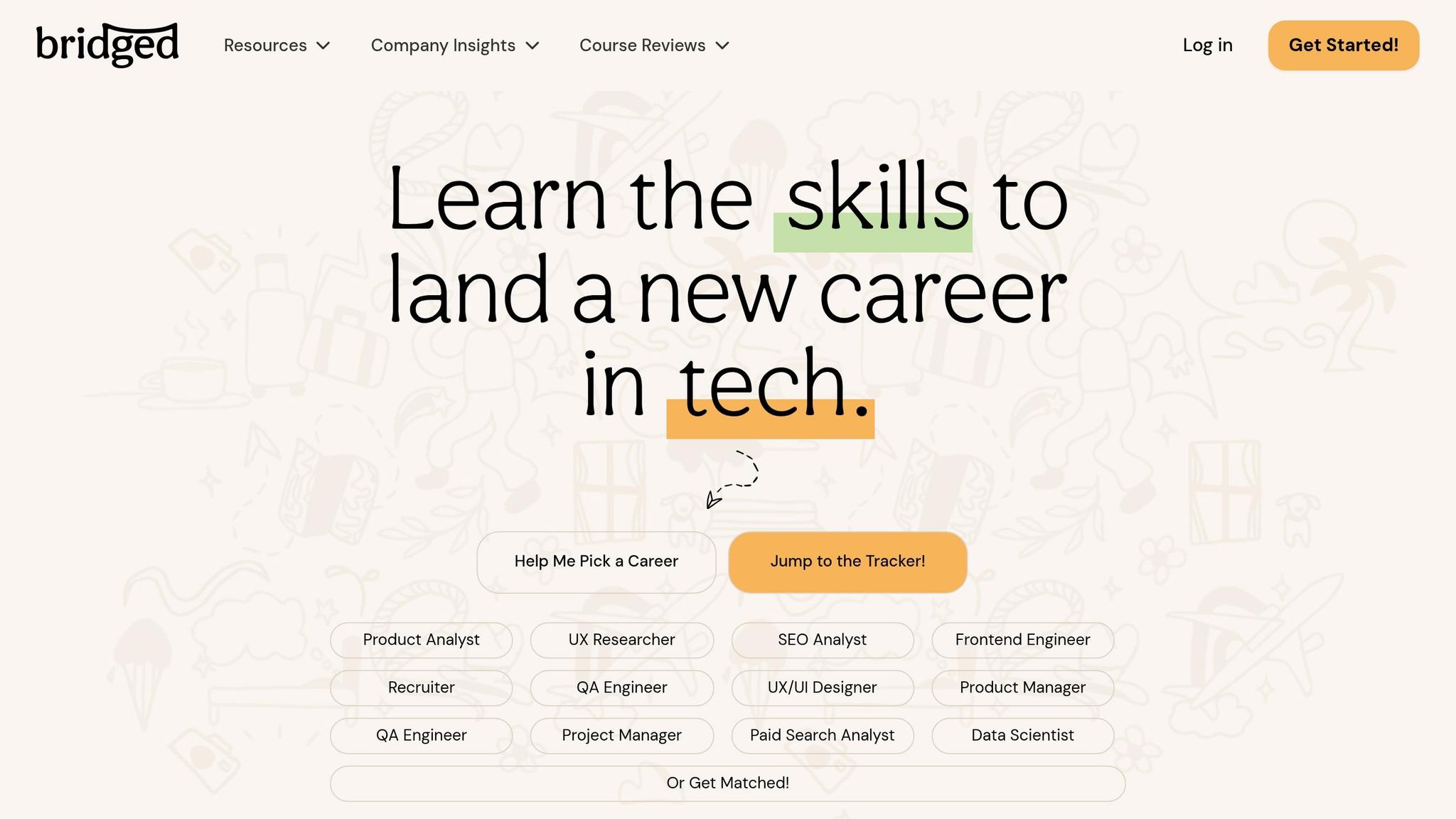
The journey starts by identifying which certifications align with the role you’re aiming for. Bridged makes this easier with a career quiz designed to match you with high-paying technical roles that suit your strengths and values. Once you’ve pinpointed your target role, the platform’s gap identifier compares your current skills to the job’s requirements, highlighting areas to improve.
Instead of leaving you to guess which certifications will help, Bridged suggests vetted programs from well-known providers like Google and AWS. As Elizabeth Hogue, Bridged Cofounder, puts it:
"Micro-certification stacking is the backbone of the Bridged experience".
This method involves combining multiple targeted certifications to meet the qualifications for entry-level technical roles. For example, you might pair Google’s Data Analytics certificate with a SQL course. To keep things moving, set a clear deadline for yourself. After that, evaluate the providers to make sure the certifications you choose hold weight with employers.
Evaluating Certification Providers
Once your career path is mapped out, the next step is assessing the credibility of certification providers. The provider you choose can significantly impact how employers view your skills and whether your application stands out in applicant tracking systems (ATS). In fact, 61% of learners prioritize accreditation and employer recognition when selecting a program. Focus on certifications from accredited universities, respected industry leaders, or professional organizations like PMI or Scrum Alliance.
Look for certifications with ACE Credit Recommendations, which can sometimes be applied toward a college degree. Programs that include hands-on projects are especially valuable, as they allow you to showcase your work on platforms like GitHub or LinkedIn. Subscription services like LinkedIn Learning (~$30/month) and Coursera (~$49/month) offer affordable options, while individual certifications on platforms like EdX and Udacity range from $9 to $1,000.
| Provider | Typical Cost | Credibility Level | Best For |
|---|---|---|---|
| Google (via Coursera) | ~$49/month | High (Industry Standard) | Data Analytics, IT Support, Entry-Level Tech |
| AWS | $100–$300 per exam | Very High (Global) | Cloud Architecture, Engineering |
| IBM | Varies | High (Technical Depth) | AI Engineering, Full Stack Development |
| Microsoft | Varies | High (Ecosystem Integration) | Business Analysis, Power BI |
| PMI | $400–$550 | Gold Standard | Project Management |
Scott Shireman, Global Head of Campus at Coursera, highlights the growing importance of these certifications:
"Industry micro-credentials are helping hiring decision-makers solve two of their biggest challenges right now: identifying and validating applicants' skills".
To maximize your chances, choose certifications from providers that are part of employer consortiums. These credentials can make your application stand out and even flag it for special attention.
Conclusion
Micro-certifications are changing the way technical professionals land high-paying jobs. Instead of relying solely on traditional degrees, candidates can now showcase verified, job-specific skills. In fact, 96% of employers acknowledge the value of these credentials in hiring decisions.
This shift toward skills-based hiring prioritizes demonstrated competencies over educational pedigree. By stacking targeted certifications, you can align your qualifications with employers’ needs, potentially earning a 10–15% salary boost compared to peers without certifications.
Platforms like Bridged make it easier to close skill gaps and connect with companies actively hiring. With tools like career quizzes and tailored certification recommendations, you can follow a clear path - from identifying your goals to landing a job. This approach eliminates the guesswork and helps you stay ahead in a competitive market.
Adaptability is key in today’s job landscape. As Leon C. Megginson famously said:
"It's not the strongest or the most intelligent who will survive, but those who can best manage change".
Choose one role to target, pursue certifications that address your skill gaps, and showcase your achievements on platforms like LinkedIn and your resume. The steps you take now can lead to higher-paying opportunities in the future.
FAQs
Which micro-certifications are most valued for my target role?
Micro-certifications that hold the most value often vary by industry and job role. In 2025, some of the most sought-after options include Project Management Professional (PMP), Certified Information Systems Security Professional (CISSP), and cloud computing credentials such as the AWS Solutions Architect. Cybersecurity certifications emphasizing hands-on skills are especially well-regarded. To boost your career opportunities, explore certifications that align with your specific field and expertise.
How do I list micro-certifications so ATS systems pick them up?
To make sure Applicant Tracking Systems (ATS) properly recognize your micro-certifications, create a dedicated "Microcredentials" section on your resume. Use clear formatting and include standard titles for each certification. Incorporate relevant, skill-focused keywords to align with the roles you're targeting.
For added impact, pair each certification with a brief, keyword-rich description. This not only boosts visibility but also helps ATS software accurately parse and identify your qualifications, increasing the likelihood of being matched with suitable job opportunities.
How many micro-certifications should I stack before applying?
The number of micro-certifications you should pursue depends largely on your career aspirations and the specific skills needed for the role you’re aiming for. As a general rule, having a handful of relevant certifications can help you develop a specialized skill set that stands out to employers. Prioritize certifications that match the technical abilities most sought after in your chosen field.
Related Blog Posts


